Aperture for Nature Photography
What is Aperture?
Aperture forms part of the exposure triangle and refers to the hole through which light passes in a photographic lens.
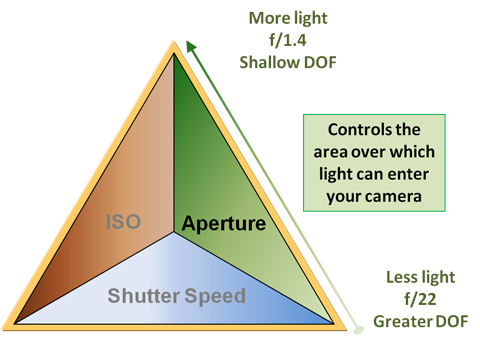
The hole is formed by a number of blades that open up and close down to make the hole bigger or smaller. It works in a similar way to the iris in the human eye. The iris (the 'blades') regulates the amount of light that passes into the eye by closing and opening the pupil (the 'hole') - in bright sun the iris contracts (closes) the pupil to limit the amount of light and in a dark room the iris dilates (widens) the pupil to let more light in.
With your eye this happens automatically because that's how God created us but you will need to set it on your camera body.
The size of the hole is measured in f-numbers or f-stops...

Each f-stop represents a factor of the amount of light that passes through the lens.
The smaller the number, the larger the hole, e.g. my Nikon 50mm f1.4 lens is my largest aperture lens, which provides least depth of field (DOF) but makes the subject 'pop'. The bigger the number the smaller the hole and the greater the DOF, f22 for example.
Each subsequent f-stop lets in double the light as the previous, so if we use f/22 as the base then f/16 will let in 2X light, while f11 will let in 4X more light than f/22 and so on until we get to f/1.4 that lets in 256X more light than f22!
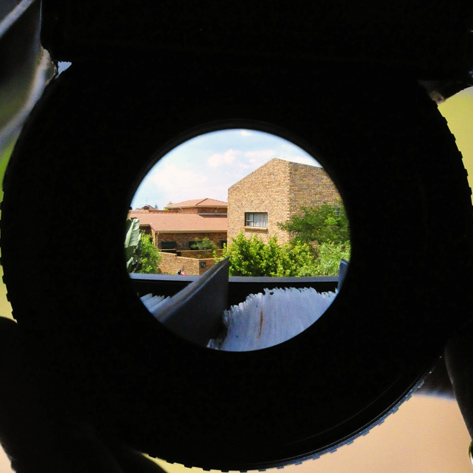
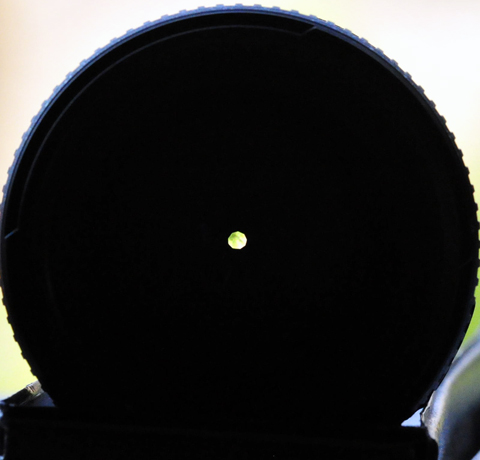
f1.4 above and f22 below - see how much light is let into the lens at f1.4 compared to the tiny hole at f22...
What does the Aperture Do?
The hole size affects the depth of field (DOF), which determines how much of a photograph is sharply in focus.
There are three main ways you control the level of DOF: camera to subject distance, lens focal length and lens-aperture but sometimes you will not be able to get closer to a subject and/or you will be limited to a certain lens focal length and this is when aperture comes to the rescue.
The wildlife photographer generally wants the subject to 'pop' so will normally choose a large hole (small f-stops such as f2.8) that produces a very narrow depth of field (subject in focus, background out of focus) and a landscape or macro photographer will choose small holes (large f-stops such as f/16 to f/22), which produce a large depth of field (everything in focus from near to far)
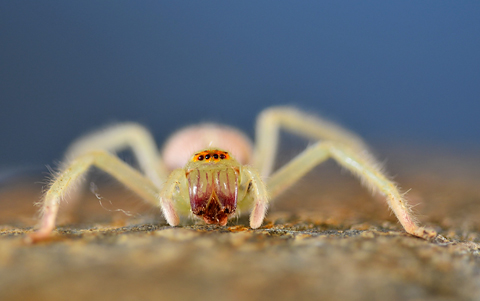
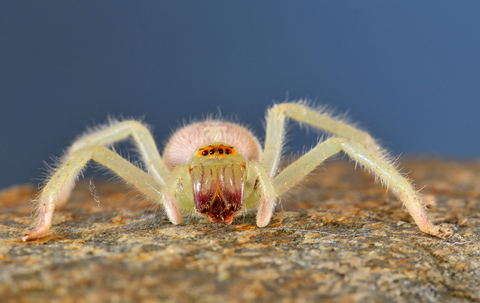
The above spider was shot at f4 (ISO 200 & 1/5 second) while the one below was shot at f22 (ISO 200 & 4 seconds). Much more of the bottom spider is in focus...
Return from Aperture to Safari Photo Tips




 Subscribe To This Site



To make a safari rental booking in South Africa, Botswana or Namibia click here
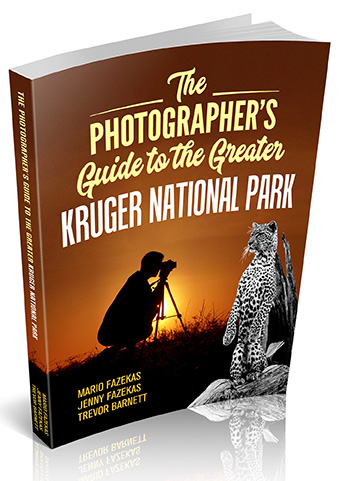
"It's 764 pages of the most amazing information. It consists of, well, everything really. Photography info...area info...hidden roads..special places....what they have seen almost road by road. Where to stay just outside the Park...camp information. It takes quite a lot to impress me but I really feel that this book, which was 7 years in the making, is exceptional." - Janey Coetzee, South Africa
"Your time and money are valuable and the information in this Etosha eBook will help you save both."
-Don Stilton, Florida, USA
"As a photographer and someone who has visited and taken photographs in the Pilanesberg National Park, I can safely say that with the knowledge gained from this eBook, your experiences and photographs will be much more memorable."
-Alastair Stewart, BC, Canada
"This eBook will be extremely useful for a wide spectrum of photography enthusiasts, from beginners to even professional photographers."
- Tobie Oosthuizen, Pretoria, South Africa
Photo Safaris on a Private Vehicle - just You, the guide & the animals!
New! Comments
Have your say about what you just read! Please leave us a comment in the box below.